Integrating ICT into Sustainable Local Policies
 by Antonio Caperna In: Handbook of Research on E-Planning: ICTs for Urban Development and Monitoring Carlos Nunes Silva (University of Lisbon, Portugal) Release Date: May, 2010. Copyright © 2010. 546 pages. The Handbook of Research on E-Planning: ICTs for Urban Development and Monitoring provides relevant theoretical perspectives on the use of ICT in urban planning as well as […] read more
 by Antonio Caperna Presented at UIA working program “Spiritual Places”, July 6th, 2007 Third International conference “Transmitting outspoken emotions” UIA WP Spiritual Places, Warsaw, Poland Abstract This paper start from two assumption: 1. the illuminist thought has represented a turning point in Western history, but its has “frozen” inside its “rational domain” part of our […]
  Using the work of Christopher Alexander and Nikos Salingaros, I present a paper that want discuss the philosophical structure that are behind The Pattern Language (PL). Through a simple way I’ll show you the intimate connection existing among the PL and other cultural aspect like painting as well as the fractal geometry. I have referred my philosophical approach especially to the work of Oswald Spengler and his work “Der Untergang des Abendlandes”
  The idea of a very effective scientific network, based upon “biophilic” architecture principles (peer-to-peer, self-organized, scaled, self-similar, and “small-world”-like network) is offered here. The network should be Russian both in language and scientific tradition, offering a paradigm for a new, hyper-connected vision of world science, based on a multi-centric epistemology.
 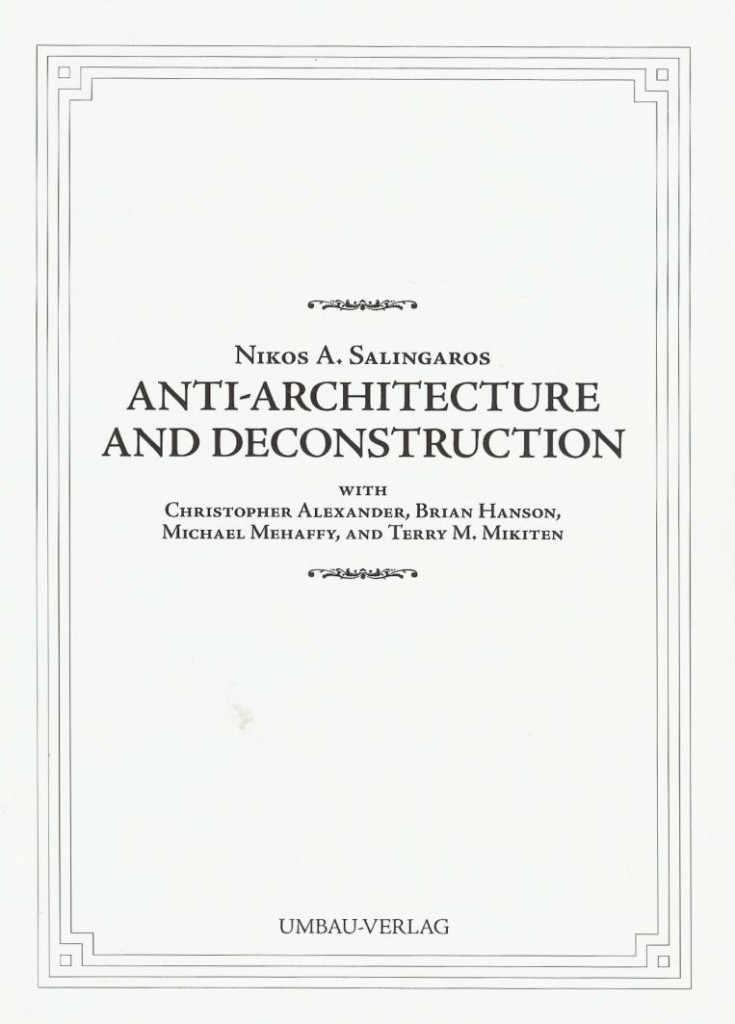 Anti Architecture and deconstruction is a collection of essays on deconstructivist architecture. This book raises questions about how the public can be indoctrinated to accept an architecture that is hostile to human sensibilities, and which often causes physiological and psychological distress. In trying to understand the adoption of an architectural fashion, writers often focus only on aesthetic points, and ignore psychological conditioning and the role of the media. I look at the dark underside of contemporary architecture, and the world that promotes and sustains it.and precedents, while distancing themselves from basic human needs and cultural contexts.