Brains, Hands, and Hearts: How Traditional Design Supports Health
 by Nikos Salingaros Department of Mathematics, University of Texas at San Antonio, United States of America Keynote address at the Traditional Architecture Conference STOA-22 DAY 2, 25 February 2022 CLICK HERE: These notes contain the slides presented at the conference, now made available for general readers. Additional explanatory remarks are included for clarity, documenting the […] read more
 by Nikos Salingaros Originally published in the Journal of Biourbanism Volume IV Issue 1&2/2015. ABSTRACT: Simple yet powerful rules that govern complex systems shed light on human environments. Built environments that evolve freely over time develop a working complexity that is characteristic of both nature and traditional urban fabric. A city or portion of city without […]
  by Michael Mehaffy and Nikos Salingaros “Only connect,” the writer E. M. Forster said famously — and modern scientists working with network structures are learning how right he was. Forster was talking about how to tell a good story, but it turns out that the same principles for creating richly interconnected structures do apply to […]
  by Nikos A. Salingaros Trying to measure the complexity of a system is not straightforward. The simplest measure of a system’s complexity reflects not so much its intrinsic complexity, or the complexity of the process that generated it, but the complexity of the system’s description. As such, this approach is not without its limitations. We […]
  by Michael W. Mehaffy and Nikos A. Salingaros Originally published in Metropolis 29, November 2011 In 1984, the environmental psychologist Roger Ulrich made a startling discovery. In studying hospital patients recovering from surgery, he found that one factor alone accounted for significant differences in post-operative complications, recovery times, and need for painkillers. It was the […]
 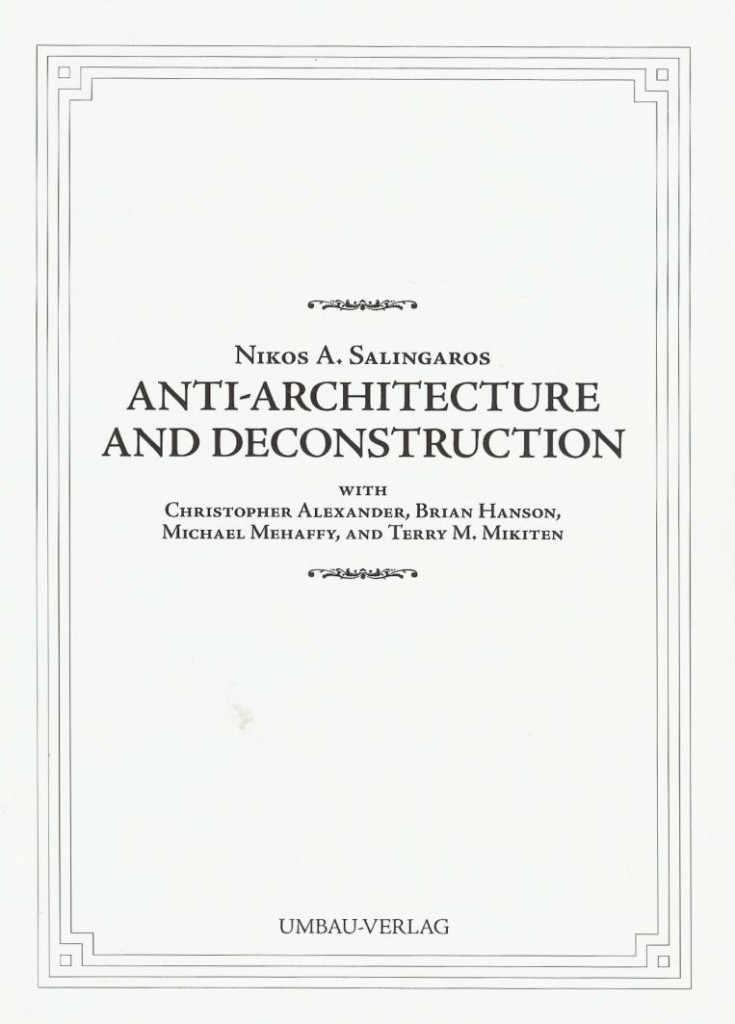 Anti Architecture and deconstruction is a collection of essays on deconstructivist architecture. This book raises questions about how the public can be indoctrinated to accept an architecture that is hostile to human sensibilities, and which often causes physiological and psychological distress. In trying to understand the adoption of an architectural fashion, writers often focus only on aesthetic points, and ignore psychological conditioning and the role of the media. I look at the dark underside of contemporary architecture, and the world that promotes and sustains it.and precedents, while distancing themselves from basic human needs and cultural contexts.